Let me be straight with you: when people say “AI is going to make everyone rich overnight,” they’re selling something. But here’s the part that is actually true — AI tools have genuinely changed what’s possible for ordinary people with ordinary laptops, even if they’ve never run a business before. I’ve spent months digging into what’s actually working in 2026, and this guide is what I wish I’d had when I started.
First, let’s be honest about what changed
In 2023, the AI hype cycle was deafening. Everyone from TikTok influencers to LinkedIn gurus was screaming that you could “make £10,000 a month with ChatGPT prompts.” Most of that was nonsense, and a lot of people burned time chasing it.
2026 is quieter — but more genuinely useful. The tools have matured enormously. AI can now reliably write, code, edit images, generate video, analyse data, and manage workflows in ways that would have seemed impossible three years ago. The noise has faded, and what’s left are actual, repeatable income streams that real people are building.
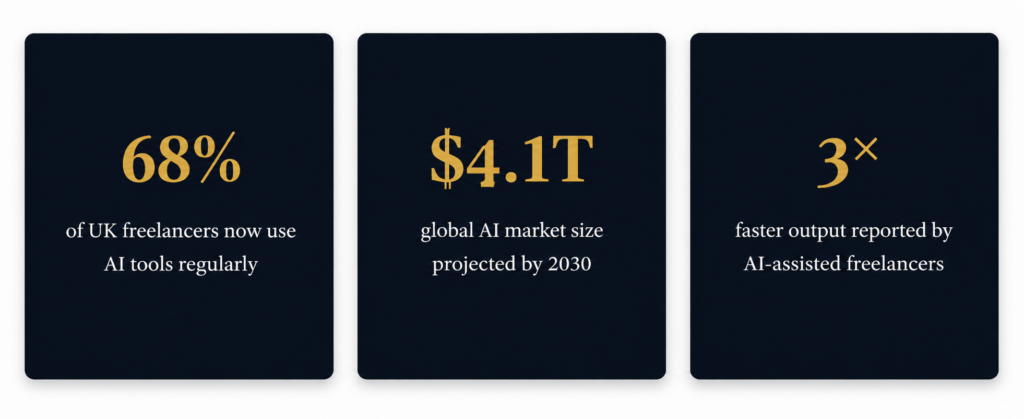
The window for early advantage is still genuinely open — but it’s narrowing. The people who start learning and building now will be miles ahead of those who wait until AI literacy is the expected baseline rather than the differentiator.
The 8 Real Ways to Earn with AI in 2026
These aren’t random ideas scraped from a listicle. These are paths that have traction right now, with real platforms, real clients, and realistic earning potential. Let’s go through them properly.
AI-Assisted Freelance Writing & Content Creation
This is still the most accessible entry point. Businesses need a constant stream of blog posts, email newsletters, product descriptions, LinkedIn content, and social media copy — and most of them genuinely struggle to produce it consistently.
Your job isn’t to let AI write everything and send it off. Your job is to use AI as a first-draft engine, then layer in your human voice, accurate research, real examples, and the kind of editorial judgement that separates good content from noise.
Platforms like Contra, Substack, and Upwork have seen huge demand for writers who are upfront about using AI tools but deliver human-quality polish. Many clients specifically prefer this because turnaround is faster and prices are competitive.
Where to start: Pick one niche — finance, health, home improvement, SaaS, whatever you actually know something about — and write three sample pieces. Then pitch small businesses or agencies directly. Cold email still works.
Building and Selling AI-Powered Products (No Code Required)
This is where it gets genuinely exciting. Tools like Bubble, Glide, and Make (formerly Integromat) combined with AI APIs mean that a non-developer can build a functional, paying product in weeks rather than years.
Think of a specific, repetitive problem in your industry. A local estate agent who needs property descriptions written in seconds. A HR manager who needs job ads drafted. A restaurant owner who needs social captions generated from a menu photo. These are all solvable with a small, focused AI tool — and people will pay for them on a subscription basis.
The sweet spot is narrow tools for specific audiences. Not “an AI writing app” — but “AI property descriptions for UK estate agents.” Niche wins.
Where to start: Browse Reddit communities, Facebook Groups, and X/Twitter for complaints about time-consuming tasks. Then prototype a solution using a tool like Cursor or Bolt and post it in the same community.
AI Automation as a Service (Done-For-You Workflows)
Most small business owners would save hours every week if their email follow-ups, social posts, invoice reminders, and customer service replies were even partially automated. They know it. They just don’t know how to do it — and they don’t want to learn.
If you can set up Zapier, Make, or n8n workflows that connect tools like Gmail, Notion, Slack, and AI models, you can charge a setup fee (typically £300–£1,500 depending on complexity) plus an optional monthly retainer for maintenance.
This is one of the highest-value skills available to beginners willing to spend a few weeks learning it. There are free courses on YouTube and Udemy that will get you to a functional level quickly.
Where to start: Build a free automation for a local business — a friend’s shop, a family member’s service — document what you did, and use it as your first case study.
AI Video and Faceless YouTube Channels
AI video tools — like Sora, Kling, Runway, and HeyGen — have made it possible to produce educational, explainer, or compilation videos without appearing on camera. Pair that with AI voiceovers (ElevenLabs remains excellent) and AI-generated scripts, and you have a genuine content machine.
Faceless YouTube channels in niches like personal finance, history, true crime, and “top 10” content have been monetising steadily for years. What’s new in 2026 is how cheap and fast the production cycle has become. A video that took a team a full day can now be assembled by one person in a few hours.
YouTube ad revenue is only part of the picture. Affiliate links, sponsorships, and Patreon memberships compound quickly if you pick the right niche and stay consistent.
Where to start: Pick a narrow, search-friendly niche. Produce 20 videos before worrying about monetisation. Consistency and searchability beat virality every time.
Selling AI-Generated Digital Products
Etsy, Gumroad, and Creative Market are full of people selling things like AI-generated printable art, Canva templates, digital planners, Lightroom presets, and prompt packs. The margins are excellent because there’s no physical fulfilment and products sell indefinitely after creation.
The honest caveat: the market for generic AI art and basic prompt collections has become saturated. The opportunity is in specialisation. A set of 50 prompts specifically for architecture photographers will sell far better than a generic “1000 ChatGPT prompts” PDF. Think deeply about who your buyer actually is.
Midjourney, Ideogram, and similar tools are producing images that are genuinely competitive with stock photography — and businesses are licensing them, especially for niche subjects that stock libraries have underserved.
Where to start: Open a Gumroad or Etsy store and launch with five highly specific products rather than 50 generic ones. Study what’s already selling by sorting by “bestseller.”
AI Coaching and Education
Here’s something many people overlook: you don’t need to be an AI engineer to teach AI. You just need to be 12 weeks ahead of your audience and communicate well. Local businesses, sole traders, schools, charities, and marketing teams are desperate to understand how to actually use these tools in their daily work — and they’ll pay for proper training.
This works as in-person workshops, live Zoom sessions, or pre-recorded courses on platforms like Teachable or Thinkific. A one-day AI workshop for a small business team of 8 people can realistically command £500–£1,200 in the UK.
The key is to be uselessly practical. Nobody wants a lecture on large language models. They want to walk away knowing how to write a better brief, respond to customer emails in minutes, or stop spending three hours on their newsletter.
Where to start: Offer a free 45-minute session to a local business or community group. Refine your material, then start charging.
AI-Enhanced SEO and Web Services
Small businesses in the UK and US are still massively underserved when it comes to basic online presence. A local plumber, a specialist solicitor, a boutique gym — most of them have a website that hasn’t been updated since 2019 and no SEO strategy at all.
AI tools like Surfer SEO, Semrush’s AI features, and Claude make it significantly faster to audit a site, identify keyword gaps, produce optimised content, and track improvements. You can take on clients who would never have been able to afford an agency, and deliver real, measurable results.
This pairs brilliantly with the writing and automation skills above. A client who needs SEO content also usually needs regular updates, which becomes a monthly retainer.
Where to start: Run a free SEO audit for three local businesses. You can do this with free tools like Ubersuggest. Use the audit as a sales conversation.
AI-Powered Social Media Management
This is one of the most in-demand, accessible services right now. Small businesses know they need to post consistently on Instagram, LinkedIn, and X — and almost all of them are failing to do it. The time it takes is the main barrier.
With AI tools handling caption drafts, hashtag research, image generation, and scheduling, one person can competently manage 4–6 client accounts. You bring the strategy and relationships; AI handles the execution volume.
The rates vary, but £300–£600 per month per client for managing 3–5 posts per week on two platforms is a common, achievable benchmark in the UK market. In the US, this can run significantly higher, particularly for service businesses.
Where to start: Manage your own social presence first. Prospective clients will check you before hiring you. Results on your own profiles are your portfolio.
Tools You Actually Need (Without Overspending)
You don’t need to subscribe to everything. Here’s what a sensible beginner stack looks like in 2026:
- Claude or ChatGPT Pro (£20/month)— Your core writing, ideation, and reasoning engine. Start with one and master it before trying others.
- Canva Pro (£12/month)— Handles most design needs including AI image generation, presentations, and social graphics. Worth it.
- Make (free tier to start)— For building automations without code. Free tier is genuinely useful for starting out.
- ElevenLabs (£5/month starter)— Voiceovers for video, podcast, or audio content. Remarkably good quality.
- Surfer SEO or Ubersuggest (free → £29/month)— If you’re doing content or SEO work, keyword research is non-negotiable.
- Notion + Notion AI (£8/month)— For managing your own projects, client work, and knowledge base.
Total monthly spend to start: roughly £40–£65. Keep it lean until you’re earning. You can always add tools as your income grows.
💡 One useful mindset: treat AI tools like a talented intern who works at superhuman speed but needs clear, detailed instructions and a human to check their work. Your value is in the direction and judgement — not the raw output.
Getting Your First Client or Customer
This is where most beginners get stuck. The income streams above are real — but they require someone to actually pay you, and that first client is always the hardest to find.
Here’s what actually works:
- Do one thing for free (briefly). Pick a local business you like and offer to do something specific for nothing. Write a month of social captions. Audit their website. Create a sample email sequence. Get one concrete result that proves the value. This is your first case study.
- Be direct about what you do. Most people never ask for business. A simple, specific email or DM that says “I help [type of business] with [specific problem] using AI tools — I recently did X for [name], and they [result]. Could I do something similar for you?” works far better than a generic “services” pitch.
- Use your warm network first. Before LinkedIn cold outreach, think about who you already know. Friends, family, former colleagues, and local connections who run businesses are far more likely to give you a first chance than strangers.
- Post about what you’re learning. LinkedIn is still effective for B2B service providers in both the UK and US. Writing about AI in a practical, non-hype way — sharing what worked, what didn’t, specific use cases — builds credibility faster than anything else.
- Join communities where your clients hang out. Not communities of other AI freelancers — communities of the people you want to serve. Small business forums, industry Slack groups, local chamber of commerce events. That’s where buyers are.
“Your first client doesn’t come from a landing page. It comes from a conversation.”
— Common wisdom among freelancers that is still completely true
⚠️ Learning without earning. This is the most common trap. People spend months reading about AI, watching tutorials, and experimenting without ever offering anything to anyone. Pick one thing. Start imperfectly. Adjust.
Trying to do too many things at once
The list of eight opportunities above is not a to-do list. It’s a menu. Pick one. Seriously. The temptation to diversify immediately is massive — and it will kill your momentum. One income stream executed well beats five half-started projects every time.
Letting AI output go out unedited
Nothing will damage your reputation faster. AI tools hallucinate facts, repeat phrases, write in a strangely flat register, and sometimes get things plainly wrong. Every piece of AI-assisted work needs a human pass. Your clients are paying for your judgement — that’s the actual product.
Underpricing everything
Because AI tools reduce the time it takes to produce work, many beginners drop their prices dramatically. Resist this instinct. Clients buy results, not hours. If you can write a month of social content in six hours using AI tools instead of thirty hours manually — you haven’t become less valuable. You’ve become more efficient. Price accordingly.
Waiting for the perfect tool or the right moment
There will always be a shinier AI tool launching next month. Build your skills with what exists now. The fundamentals — clear communication, understanding client needs, delivering on promises — don’t change regardless of which model is currently trending.
A Realistic 90-Day Plan
This isn’t a fantasy roadmap. This is what an achievable first three months looks like if you treat this seriously but fit it around an existing job or life.
Days 1–30: Learn and Build
Choose one income stream from the list above. Spend your first month genuinely learning the tools involved — not consuming endless content, but producing things. Write 10 pieces of AI-assisted content. Build one small automation. Create five digital products. Whatever fits your chosen path. Build a basic portfolio, even if it’s just samples you created for yourself.
Days 31–60: Find Your First Client or Customer
Put yourself in front of potential clients or customers using the methods above. Offer something at a reduced rate or for free to one person in exchange for honest feedback and a testimonial. Learn what they actually value versus what you assumed they’d value. This gap is always instructive.
Days 61–90: Refine and Grow
Take what you learned from your first client interaction and apply it. Tighten your process. Start charging properly. Build a simple one-page website or LinkedIn profile that explains what you do and shows evidence that you do it well. Look for client number two and three.
💡 A reasonable 90-day goal: £200–£800 in early income, a clear focus, and two or three pieces of evidence that you can actually deliver results. That’s a solid foundation — not a yacht, but a genuine start.
The Bigger Picture
Here’s the thing nobody says clearly enough: the money from AI tools isn’t actually coming from the AI. It’s coming from your ability to solve a real problem for a real person more efficiently than before. AI is the leverage. You are still the person who has to understand the problem, communicate clearly, build the relationship, and care about the outcome.
The most durable opportunities in this space — in 2026 and beyond — are not the ones that involve hiding behind automation and hoping nobody notices. They’re the ones where you use AI to become genuinely better at serving people: faster, more consistent, more creative, more affordable.
That combination — human judgement plus AI efficiency — is exactly what most businesses are trying to find and mostly failing to find in-house. If you can be that person for them, you’ll have no shortage of work.
Start small. Pick one thing. Be honest about what you can and can’t do. Deliver on your promises. The rest will compound.